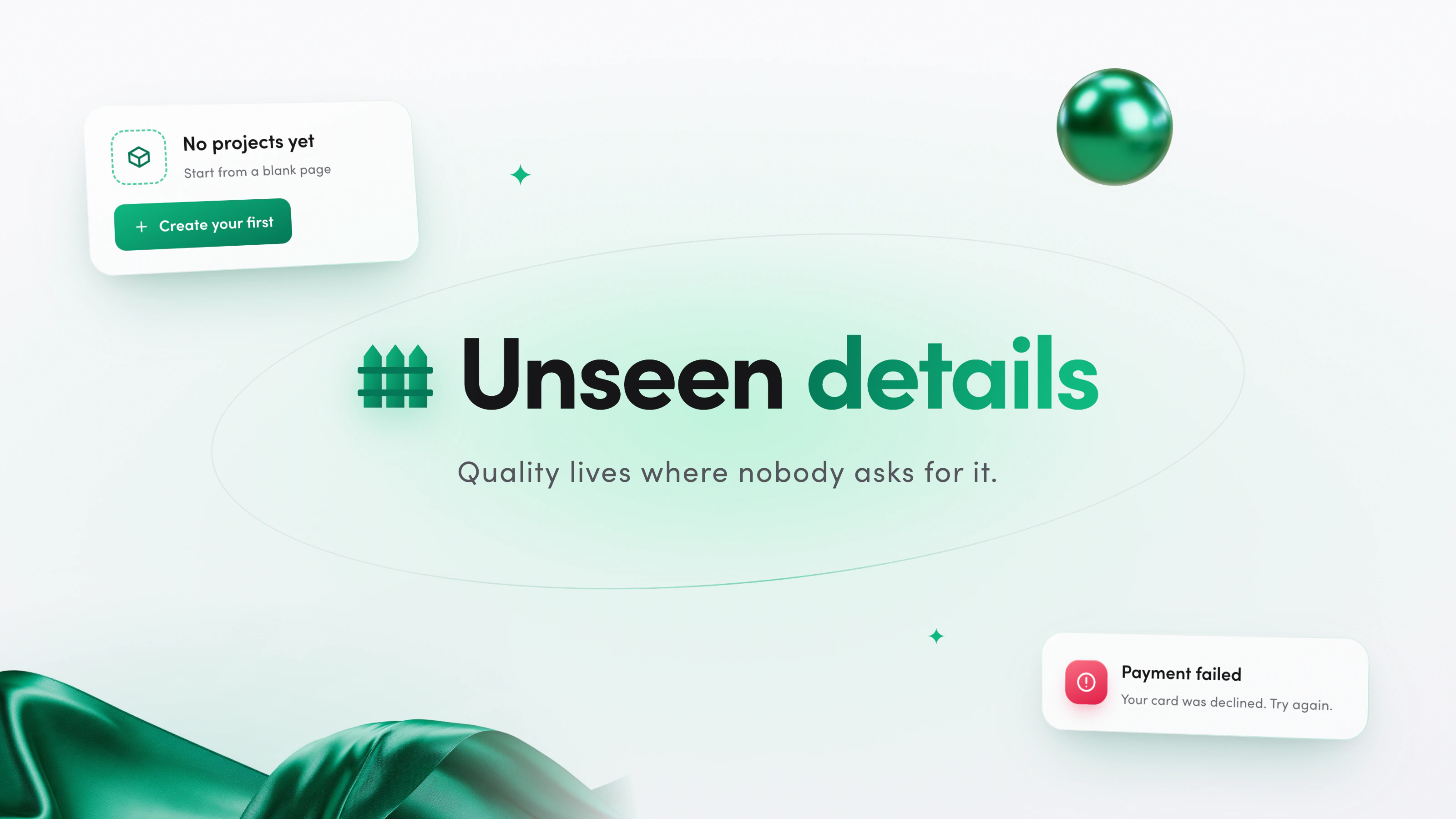
Build the back of the fence
Steve Jobs liked to tell a story about his father, Paul, building a fence. Paul told him to make the back of the fence, the side facing away from the street, as good as the front. Nobody would ever see it, Paul said, but Steve would know. Jobs carried that rule into Apple, where it showed up as tidy circuit boards inside machines no customer would ever open.
That story is the most useful definition of quality I know. Quality is what you get when every decision gets deliberate attention, including the decisions nobody will notice on their own.
Quality lives in the details nobody asks for
In software, the back of the fence is everywhere. It’s the empty state a new user sees before they’ve added anything, the error message when a payment fails, the curve of a sheet sliding up, the focus ring for someone navigating by keyboard. No customer files a feature request for any of these. They notice them anyway, usually as a vague sense that a product feels cheap or feels solid.
Speed is part of it too. Craig Mod once timed Photoshop taking three to five seconds to open its export screen. Each wait is small. Over a day of work they add up to a tool that feels like it’s fighting you.
Quality comes from culture
A culture built on the fence rule is part of how Apple walked into categories it didn’t invent and reset them: MP3 players with the iPod in 2001, smartphones with the iPhone in 2007.
That culture didn’t guarantee wins. The original HomePod was discontinued in 2021 after reportedly weak sales, and Siri has trailed its rivals for years. Caring about quality raises your odds without promising anything.
Linear made quality its strategy
Linear is the clearest recent case. Founded in 2019 by Karri Saarinen, Tuomas Artman and Jori Lallo, it opens its published Method by saying that building truly high-quality software has become a lost art. The product backs that up. It responds instantly, and nearly everything in it can be done from the keyboard. In a category known for slow, cluttered project trackers, that was enough to make people switch.
Quality is hard to copy
A competitor can copy your feature list. Copying a team that cares about the back of the fence takes years, because it means hiring people with taste and then giving them the time to use it. That’s why quality is rare, and why it lasts once a team has it.
Spencer Camp